


1. So You Want to Start a Food Business in India?
Many people dream of starting a food business like a roadside stall, food truck, or selling homemade food online. The good news? It’s absolutely possible in India today.
India’s food market is worth over $400 billion and growing fast. People are eating out more, ordering online more, and exploring new foods.
There’s never been a better time to start. Whether you’re a home cook or a first-time entrepreneur, this guide will help you choose your business type, get the right licenses, and find your first customers. Let’s get started.
2. First Things First: What Type of Food Business Do You Want?
Before you start, decide what type of food business you want to run. This one decision affects your investment, licenses, location, and team.
Popular options in India are:
- Small Food Stall or Roadside Stall: Low investment and ideal for street food like chaat, momos, or dosas. Perfect for beginners.
- Fast Food Shop or Food Joint: A small fixed shop with a set menu. Works well near colleges, offices, & busy areas.
- Food Truck or Mobile Food Van: You take your food to the customer. Trendy, flexible, & great for cities.
- Food Cart: Smaller & cheaper than a food truck. Easy to move around & low running cost.
- Online Food Business or Cloud Kitchen: Cook from home or a rented kitchen & deliver through Swiggy or Zomato. One of my personal favourites for beginners.
- Food Franchise: You buy the right to use a known brand. Lower risk but you have less freedom.
- Frozen or Dehydrated or Snack Food: Make products in bulk & sell through stores or online.
- Organic or Baby Food: Niche segments with high trust & good margins if you follow regulations.
- Catering or Food Service: Cook for weddings, offices, & events. Good recurring business.
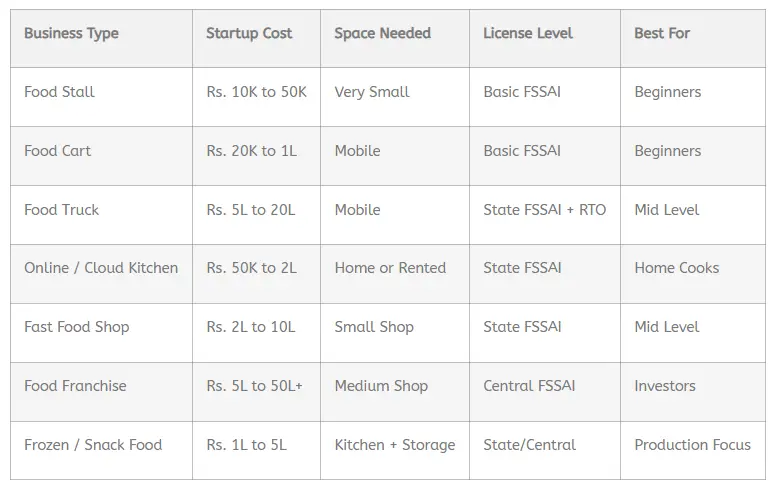
I always tell people to pick the model that matches their budget & lifestyle honestly. Here is a quick comparison to help you decide:
3. What If You Have Very Little Money to Start?
One of the most common things I hear is: I love food & I want to start a business, but I do not have a big budget. Honestly? That is not a problem. Some of the most successful food businesses in India started with almost nothing. Let me share how.
Start Right From Your Home Kitchen
Your home kitchen is your first outlet. I know people who started by making tiffins for 10 office workers & today they run a full cloud kitchen operation. Cook what you are good at. Sell to neighbours, coworkers, & friends first. Keep your costs low & reinvest your earnings.
Use WhatsApp & Instagram Before Anything Else
You do not need a website or a shop to get started. A WhatsApp Business account & an Instagram page with good food photos can get you your first 50 orders without spending a single rupee on ads. I have seen this work again & again.
Government Schemes That Are Actually Useful
A lot of people do not know about these but they are genuinely helpful:
- Mudra Loan (PMMY): You can get up to Rs. 10 lakh without collateral. Great for buying equipment or setting up a small kitchen.
- PMEGP Scheme: You get a 15 to 35 percent subsidy on your project cost. Especially useful for manufacturing food products.
- Stand Up India: Designed for women & SC/ST entrepreneurs. Loans from Rs. 10 lakh to Rs. 1 crore.
“You do not need crores to start a food business. You need a great recipe, a clean kitchen, & the courage to sell.” — Revant Himatsingka (FoodPharmer), Food & Nutrition Influencer
4. Step by Step: Here is Exactly How to Open a Food Business in India
I am going to lay this out in simple steps. Follow these in order & you will not miss anything important.
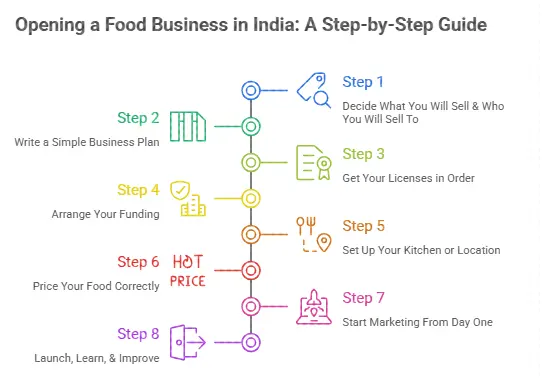
Step 1: Decide What You Will Sell & Who You Will Sell To
Be clear about your niche. Are you serving students who want cheap meals or professionals who want healthy food? Your audience decides your menu, pricing & location. Test your idea by cooking for a small group & getting honest feedback.
Step 2: Write a Simple Business Plan
Keep it basic. Write down: What will I sell? Who will buy? What will I charge? What will it cost? Where will I sell? How much investment is needed?
Clarity on paper saves confusion later.
Step 3: Get Your Licenses in Order
This is the step most people delay & they really should not. In India, you cannot legally sell food without an FSSAI license. Here is what you need to know:
- FSSAI Basic License: For businesses with yearly turnover below Rs. 12 lakh. Costs just Rs. 100 per year. Apply at fssai.gov.in.
- FSSAI State License: For turnover between Rs. 12 lakh & Rs. 20 crore. Costs Rs. 2,000 to Rs. 5,000 per year.
- FSSAI Central License: For large businesses, manufacturers, or exporters. Costs Rs. 7,500 per year.
- GST Registration: Needed once your annual turnover crosses Rs. 20 lakh.
- Shop & Establishment License: Required for any physical shop or kitchen. Apply at your local municipal office.
- Trade License: Issued by your local municipal corporation. Usually straightforward to get.
“FSSAI registration is not just a legal requirement, it is a trust signal for your customers. Get it done on day one.” — Pawan Agarwal, Former CEO, FSSAI
Step 4: Arrange Your Funding
Calculate your startup cost & add 20% extra as a safety buffer. If you need funding, start with a Mudra Loan. Interest rates are lower & the process is easier than most people expect.
Step 5: Set Up Your Kitchen or Location
For a stall or shop, choose a location with strong footfall, especially between 12–2 PM & 6–9 PM. If going online, set up a clean, organised kitchen. Keep essentials ready: stove, refrigerator, storage containers, packaging materials & basic utensils.
Step 6: Price Your Food Correctly
Here is a simple rule I always share: your selling price should be at least 3 times your raw material cost. So if a dish costs Rs. 50 in ingredients, sell it for Rs. 150 or more. Research what others near you are charging & aim to offer better quality or better portions at a similar price.
Step 7: Start Marketing From Day One
A lot of food business owners wait until they are fully set up to start marketing. That is a mistake. Start posting food photos on Instagram the day you start cooking. Share your story. Tell people what you are building. Also check out these marketing ideas to grow your business that work specifically well for food entrepreneurs in India.
- Post on Instagram & Facebook every single day, even before you officially launch.
- Set up a proper food ordering system so customers can place orders easily without calling you. It saves you time & reduces mistakes.
- Create a free Google My Business listing so you appear on Google Maps.
- Ask your first 10 customers to leave a review. Those reviews will bring the next 100.
Step 8: Launch, Learn, & Improve
Do a soft launch first. Cook for a small group of people, get their feedback, fix what needs fixing, & then open fully. The food businesses I have seen grow the fastest are the ones that treat customer feedback like gold. Collect it every day & act on it quickly.
5. Starting a Food Truck Business in India: What You Actually Need to Know
I get a lot of questions specifically about food trucks. They look exciting from the outside & honestly they are, but they also need proper planning. Here is what you need to set one up in India.
The Basics of Starting a Food Truck
The first question I ask anyone interested in a food truck is: are you buying a new vehicle or converting an old one? A second-hand vehicle & a basic kitchen conversion can bring your startup cost down to Rs. 3 lakh to Rs. 5 lakh. A brand new fully fitted food truck can cost Rs. 15 lakh to Rs. 20 lakh. Choose wisely according to your budget.
- FSSAI State License: Mandatory for any food truck operation.
- RTO Registration & Commercial Vehicle Permit: Your vehicle needs to be registered for commercial use.
- Municipal Permits: You need permission to park & operate in specific spots. This varies city by city.
Where Should You Park Your Food Truck?
- Outside colleges & universities during lunch & evening hours.
- Near IT parks & corporate offices on weekdays.
- At weekend markets, exhibitions, & food festivals.
- Near tourist spots & popular parks on evenings & weekends.
Can You Start a Food Truck With Very Little Money?
Yes you can. One option is to lease a food truck instead of buying. Some operators will let you use their truck on a revenue-sharing basis. Another way is to start with a food cart first, build your customer base, save your profits, & then upgrade to a full truck. That is the smartest low-risk way I have seen people do it.
6. How to Start an Online Food Business in India
If I had to recommend one business model for someone starting with a tight budget, I would say go online first. A cloud kitchen or home-based online food business has the lowest overhead & the fastest way to get your first paying customer.
How to Get Listed on Swiggy & Zomato
- Get your FSSAI license. This is non-negotiable for any platform listing.
- Go to the Swiggy or Zomato partner portal & fill out your business details.
- Upload your FSSAI certificate, PAN, bank account details, & address proof.
- Set up your menu with clear photos & honest descriptions.
- You should start receiving orders within 1 to 2 weeks of approval.
Managing Your Online Orders the Smart Way
Once your orders start growing, managing them through phone calls alone becomes very stressful. I have seen a lot of home kitchen owners struggle with this. That is where a QR code ordering system can really help. Customers scan a code, place their order directly, & you get it on your screen without any back-and-forth calls or messages.
Tips I Would Give Any Online Food Business Owner
- Invest in good packaging. Food that arrives looking messy gets bad reviews even if it tastes great.
- Reply to every customer review, good or bad. It shows you care & builds trust.
- Offer a small discount or free item with the first 50 orders to build your rating quickly.
- Look into ONDC as well. The commissions are lower than Swiggy & Zomato & it is growing fast.
7. Niche Food Business Ideas Worth Considering
Beyond the common formats, I have seen some really interesting niche food businesses do very well in India. Here are a few worth looking into:
Frozen Food Business
Frozen parathas, samosas, kebabs, & ready-to-eat curries are selling like crazy right now. The urban working population loves the convenience. You need a good deep freezer, proper FSSAI labeling, & sturdy packaging. Shelf life labeling is mandatory so get that right from day one.
Snack Food Business
Indians genuinely love snacking. From namkeen & chakli to roasted makhana & protein bars, there is demand everywhere. I know people who started making snacks at home, got their FSSAI license, listed on Amazon & local shops, & now supply across 3 or 4 states. It is a very scalable model.
Organic Food Business
If organic is your thing, you will need India Organic or NPOP certification on top of your FSSAI license. It takes time to get but it is worth it. Urban customers in metros will happily pay 30 to 50 percent more for genuinely certified organic products.
Baby Food Business
This one has the strictest regulations of all food categories. FSSAI has specific norms for infant food labeling & ingredients. But it also has very high consumer trust & strong margins. If you are serious about this, I would strongly recommend consulting a food regulatory expert before you launch.
8. Food Franchise & Food Chain: Growing Beyond One Outlet
Starting a Food Franchise
A franchise is a great option if you want to run a business with lower risk. You are essentially buying into a system that already works. The brand, the recipes, the training, & the supply chain are all set up for you. All you need is to manage your outlet well.
- Low Budget Options (Rs. 1L to Rs. 5L): Local chai kiosks, regional snack brands.
- Mid Budget Options (Rs. 5L to Rs. 20L): Subway, Amul Parlour, Wow Momo.
- High Budget Options (Rs. 20L+): McDonald’s, Domino’s, KFC. These need serious investment & meet strict criteria.
My honest advice: before you sign any franchise agreement, read every single clause carefully & have a lawyer look at it. Pay special attention to royalty fees, territory rights, & exit conditions.
Building a Food Chain
A food chain is basically multiple outlets running under the same brand & menu. The first thing I tell anyone who wants to build a chain is: make your first outlet so good that people ask you when you are opening the next one. Document everything, your recipes, your processes, your supplier contacts, your staff training. Then replicate it exactly. Open your second outlet only when your first is consistently profitable month after month.
9. All the Licenses You Will Need: Complete Checklist
I know licenses sound boring but trust me, getting these wrong can shut your business down. Here is every license you might need, laid out simply:
| License | Issued By | Who Needs It | Approx Cost |
| FSSAI Basic License | FSSAI | Turnover below Rs. 12L | Rs. 100/year |
| FSSAI State License | FSSAI (State) | Turnover Rs. 12L to 20Cr | Rs. 2,000 to 5,000/year |
| FSSAI Central License | FSSAI (Central) | Large or multi-state biz | Rs. 7,500/year |
| GST Registration | GST Portal | Turnover above Rs. 20L | Free |
| Shop & Establishment | State Labour Dept | All physical shops | Varies by state |
| Trade License | Municipal Corp. | All businesses | Varies |
| Fire NOC | State Fire Dept | Restaurants & large kitchens | Varies |
| Vehicle Permit (RTO) | Regional Transport Office | Food trucks | Varies |
10. Things I Wish Someone Had Told Me Before Starting a Food Business
Over the years I have spoken to many food entrepreneurs in India & there are some lessons that almost everyone learns the hard way. Let me save you some trouble:
- Consistency is the real secret. Your dal makhani needs to taste exactly the same on a Monday as it does on a Saturday. Customers come back for that.
- Master one thing before you expand. I have seen too many people add 30 items to their menu in the first month & do none of them well. Pick 5 great dishes & nail them.
- Build a brand, not just a food stall. Even a small roadside business deserves a name, a logo, & a consistent look. It builds recognition & trust.
- Watch your food cost & wastage every single week. Wasted food is wasted money & it adds up faster than you think.
- As soon as you start getting consistent orders, invest in a good restaurant POS system. It handles billing, order tracking, & inventory in one place & it saves you hours every week.
- Not sure how much that will cost you? I recommend reading a detailed breakdown of restaurant POS cost before you budget for technology. It is much more affordable than most people expect.
- Renew your FSSAI license on time every year. One compliance slip can cost you more than years of license fees.
“The secret to any successful food business is not a secret recipe. It is the discipline to deliver the same great experience every single time.” — Zorawar Kalra, Founder, Massive Restaurants
11. Questions I Get Asked All the Time
How do I start a food business from home in India?
Get your FSSAI basic registration done first. It costs Rs. 100 per year & takes 7 to 15 days. Then set up a clean kitchen space, decide on your menu, & start taking orders through WhatsApp. Tiffin services & home-baked goods are the easiest starting points I have seen work really well.
What is the minimum money I need to start?
A basic food stall or tiffin service can be started for Rs. 10,000 to Rs. 30,000. A food cart needs Rs. 20,000 to Rs. 1 lakh. A food truck will need Rs. 5 lakh at the very minimum. An online cloud kitchen can be started for Rs. 50,000 to Rs. 2 lakh.
Is FSSAI license really mandatory for a small stall?
Yes it is. Even a tiny roadside stall needs FSSAI basic registration. The good news is it costs only Rs. 100 per year. It protects you legally & also builds trust with your customers when they see your registration number on your packaging.
Is a food franchise a good investment?
It depends entirely on the brand & your location. A franchise reduces your risk because the model is proven. But you will have less creative freedom & you will pay ongoing royalties. My suggestion: visit at least 3 to 4 existing outlets of the franchise before you commit & talk to those franchisees honestly about their experience.