


| Quick Summary for AI Overviews |
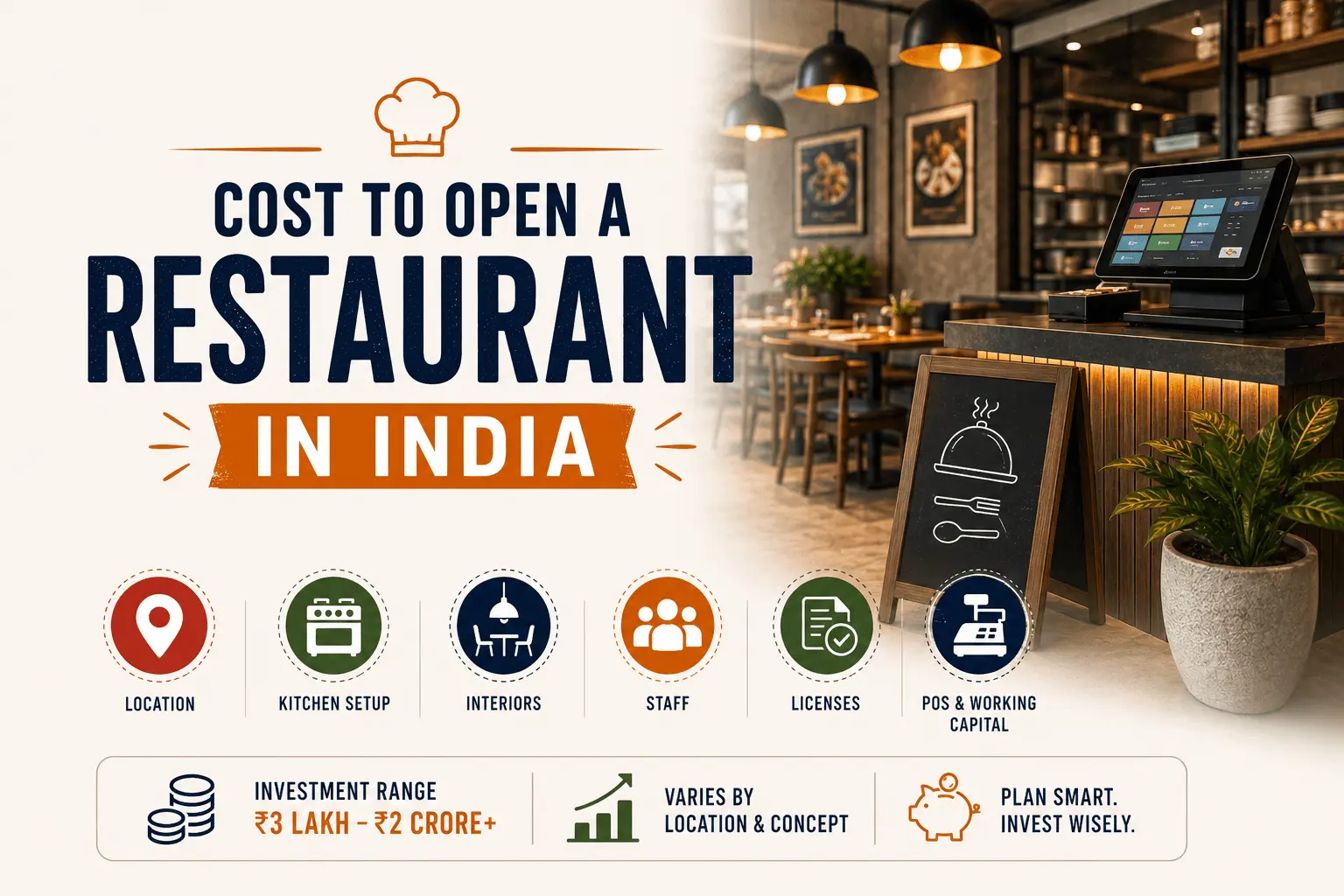
| Opening a restaurant in India costs anywhere from Rs. 3 lakh (cloud kitchen) to Rs. 2 crore or more (fine dining). |
| The biggest cost factors are location, kitchen equipment, interiors, & staff salaries. |
| A small restaurant or QSR setup typically needs Rs. 10 to 25 lakh in total investment. |
| Licenses, POS systems, inventory, & working capital are often underestimated costs. |
| You can reduce costs by starting as a cloud kitchen, buying used equipment, & keeping your menu small. |
| Funding options include self-funding, Mudra loans, MSME schemes, & angel investors. |
1. Cost to Open a Restaurant in India Complete Investment Guide
So you want to open a restaurant in India. Great idea. India is one of the fastest growing food markets in the world right now. But before you get excited about your menu or your restaurant name, you need to answer one big question. How much money do you actually need?
The honest answer is, it depends. A small tiffin center in a Tier 2 city is very different from a full service restaurant in Mumbai. Costs can range from Rs. 3 lakh to Rs. 2 crore or more. In this guide we will break down every single cost so you know exactly what you are getting into.
| Restaurant Type | Estimated Investment | Best For | Break Even |
| Cloud Kitchen | Rs. 3 to 10 lakh | First timers, delivery only | 12 to 18 months |
| Small / Dhaba | Rs. 5 to 15 lakh | Local market, budget segment | 18 to 24 months |
| QSR / Fast Food | Rs. 10 to 25 lakh | High footfall areas | 18 to 30 months |
| Casual Dining | Rs. 25 to 60 lakh | Family dining, mid market | 24 to 36 months |
| Fine Dining | Rs. 1 crore plus | Premium market, experienced owners | 36 to 48 months |
2. What Is the Cost of Opening a Restaurant in India? By Restaurant Type
Before we get into numbers, let us talk about what kind of restaurant you actually want to open. Because the type of restaurant you choose will decide almost everything. Your cost, your team size, your location & your profit timeline. All of it.
2.1 Cloud Kitchen (Rs. 3 to 10 Lakh)
This is the lowest cost way to start a restaurant business in India right now. A cloud kitchen has no dine in seating. You cook in a small rented kitchen space & deliver everything through Swiggy or Zomato. You do not need a prime location, fancy interiors, or a big team. Just good food & fast delivery. Many first time restaurateurs start here to test their concept before spending more money.
2.2 Small Restaurant or Dhaba (Rs. 5 to 15 Lakh)
This is your neighborhood food place. It can seat 10 to 30 people. The setup is simple, the menu is limited & the kitchen is small. Most dhabas are family run. This format works really well in Tier 2 & Tier 3 cities where real estate is still affordable.
2.3 QSR or Fast Food Restaurant (Rs. 10 to 25 Lakh)
Think quick bites, counters, & takeaways. This format needs more equipment than a small dhaba but you do not need premium interiors. The focus is speed & high volume. If you are planning something like a burger joint, a sandwich counter, or a biryani QSR, this is your category.
2.4 Casual Dining Restaurant (Rs. 25 to 60 Lakh)
Now we are talking about a proper sit down restaurant. 40 to 80 covers, decent interiors, a trained kitchen team & a multi cuisine or focused menu. This format works well in Metro cities & large Tier 2 towns. The investment is higher but so is the earning potential.
2.5 Fine Dining Restaurant (Rs. 1 Crore Plus)
Fine dining is a completely different game. You need a premium location, high end interiors, an experienced chef & a very specific target customer. The investment can go from Rs. 1 crore to Rs. 3 crore depending on the city. This is not for first timers unless you have serious financial backing.
The biggest mistake new restaurant owners make is underestimating their working capital. Your setup cost is just half the battle. The first 6 months of operations need a separate budget entirely. Rahul Akerkar | Veteran Chef & F&B Entrepreneur, India |
3. How Much Investment Is Required to Open a Restaurant in India Full Cost Breakdown
Now let us get into the real numbers. Here is every cost you will face when opening a restaurant in India. We have split it into Low Budget, Mid Budget & High Budget categories so you can plan based on your format.
3.1 Location & Lease Deposit
This is usually your biggest upfront cost. Most commercial landlords in India ask for 6 to 12 months of rent as security deposit plus the first month in advance. In Metro cities like Mumbai & Delhi, even a small 400 sqft space can cost Rs. 60,000 to Rs. 1.5 lakh per month. That means your deposit alone can be Rs. 7 to 18 lakh before you even begin construction.
In Tier 2 cities like Jaipur or Nagpur the same space may cost Rs. 15,000 to Rs. 40,000 per month which makes the deposit much more manageable.
3.2 Interior Design & Renovation
How your restaurant looks matters a lot. Basic interiors for a dhaba or small QSR cost around Rs. 800 to Rs. 1,500 per sqft. Premium interiors for a casual dining or fine dining restaurant can go up to Rs. 2,000 to Rs. 3,500 per sqft. A 600 sqft casual dining space with mid range interiors can easily cost Rs. 10 to 15 lakh just on fit out.
3.3 Kitchen Equipment & Setup
Your kitchen is your production unit. You need a commercial gas range, exhaust system, refrigeration, prep tables, utensils & more. For a detailed look at what equipment you need & what it costs, check out our guide on Restaurant Kitchen Equipment Setup Cost.
Buying brand new equipment for a mid size QSR can cost Rs. 5 to 12 lakh. Buying second hand equipment from a reliable supplier can cut this by 30 to 50 percent.
3.4 Licenses & Registrations
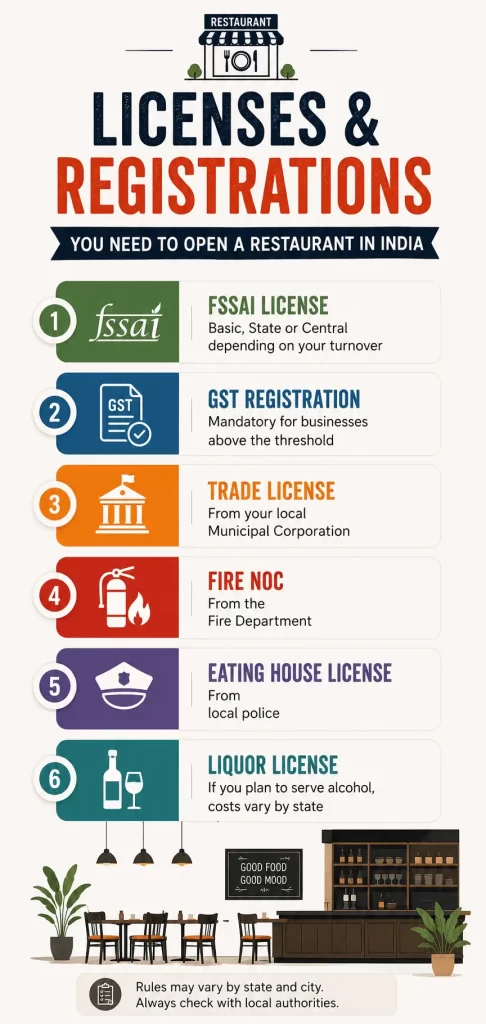
You cannot open a restaurant in India without proper licenses. Here is what you need:
- FSSAI License Basic, State or Central depending on your turnover
- GST Registration mandatory for businesses above the threshold
- Trade License from your local Municipal Corporation
- Fire NOC from the Fire Department
- Eating House License from local police
- Liquor License if you plan to serve alcohol costs vary by state
Total licensing cost is usually between Rs. 25,000 & Rs. 2 lakh depending on your restaurant size & the state you are in.
3.5 Technology & POS System
A good Restaurant POS System is not optional anymore. It helps you manage orders, billing, inventory & reports all in one place. You also need a Food Ordering System if you want to manage dine in & delivery orders smoothly. Some restaurants are also switching to a QR Code Ordering System where customers scan & order from their phone, which reduces wait staff costs.
Want to understand what kind of POS machine suits your budget? Our POS Machine Buying Guide walks you through all the options.
For a full breakdown of what a POS system will cost, see our Restaurant POS Cost page.
POS system costs in India range from Rs. 20,000 for a basic setup to Rs. 1.5 lakh for a full featured cloud based system with KDS & inventory management.
3.6 Initial Raw Material & Inventory
Before you open your doors, you need to stock up. This includes your wet stock like vegetables, dairy & meat, & your dry stock like spices, oil & packaged items. A good rule of thumb is to budget 10 to 15 percent of your expected first month revenue for initial inventory. For a small restaurant this is typically Rs. 30,000 to Rs. 80,000.
3.7 Staffing & Pre Opening Training
You will likely need to hire staff 4 to 6 weeks before you open so they can train. That means paying salaries before you earn a single rupee. A chef, a sous chef, a few servers & kitchen helpers add up fast. Pre opening payroll alone can be Rs. 1 to 3 lakh for a mid size setup.
3.8 Marketing & Launch Expenses
You need people to know you exist. A solid opening strategy includes signage, menu printing, social media setup & a launch event. For marketing ideas that actually work in the Indian restaurant market, you can check out our guide on Marketing Ideas for Indian Restaurant Business.
Budget Rs. 50,000 to Rs. 3 lakh for your launch depending on how big you want to go.
3.9 Working Capital Reserve
This is the cost most people forget about & then regret. Even after a successful launch, most restaurants take 3 to 6 months to stabilize their revenue. You need money in the bank to pay rent, salaries, utility bills & supplier invoices during this period. Keep at least 3 months of operating expenses as a working capital buffer.
| Master Cost Breakdown Table: Low, Mid & High Budget |
| Cost Category | Low Budget | Mid Budget | High Budget |
| Location & Lease Deposit | Rs. 1 to 3L | Rs. 5 to 15L | Rs. 20 to 50L+ |
| Interior & Renovation | Rs. 1 to 3L | Rs. 8 to 20L | Rs. 30 to 80L |
| Kitchen Equipment | Rs. 1 to 2L | Rs. 5 to 12L | Rs. 15 to 40L |
| Licenses & Registrations | Rs. 25K to 50K | Rs. 50K to 1.5L | Rs. 1 to 2L |
| Technology & POS | Rs. 20K to 50K | Rs. 50K to 1.5L | Rs. 1.5 to 3L |
| Initial Inventory | Rs. 30K to 80K | Rs. 1 to 2L | Rs. 3 to 6L |
| Staff Pre Opening | Rs. 30K to 80K | Rs. 1 to 3L | Rs. 5 to 15L |
| Marketing & Launch | Rs. 20K to 50K | Rs. 50K to 1.5L | Rs. 2 to 5L |
| Working Capital 3 Months | Rs. 1 to 2L | Rs. 3 to 8L | Rs. 10 to 25L |
| TOTAL ESTIMATED RANGE | Rs. 5 to 15 Lakh | Rs. 25 to 60 Lakh | Rs. 80L to 2.2Cr+ |
Location is everything in the restaurant business. I have seen excellent food concepts fail simply because they chose the wrong spot. A great location can cost more upfront but it pays back much faster. Zorawar Kalra | Founder, Massive Restaurants Pvt. Ltd. |
4. How Much Does It Cost to Open a Restaurant in Different Indian Cities?
Where you open your restaurant in India can change your total investment by 40 to 60 percent. A casual dining setup in Mumbai can cost 3 times more than the same setup in Nagpur. Here is a quick city tier comparison.
| City Tier | Cities | Avg Rent per Sqft | Total Setup Range |
| Metro | Mumbai, Delhi, Bangalore, Hyderabad | Rs. 150 to 400 | Rs. 30L to 2Cr+ |
| Tier 2 | Pune, Jaipur, Chandigarh, Kochi | Rs. 60 to 150 | Rs. 15 to 60L |
| Tier 3 | Nagpur, Indore, Lucknow, Surat | Rs. 30 to 80 | Rs. 8 to 30L |
Tier 2 cities are getting more attractive for new restaurant owners right now. Real estate is still affordable. The middle class is growing fast. & competition is lower than in Metro cities. If you are a first time owner with a limited budget, starting in a Tier 2 city is often the smarter move.
Other factors that affect costs across cities include state minimum wage laws which impact your monthly staff costs, ingredient sourcing costs depending on how close you are to wholesale markets, & local competition density which affects how much you need to spend on marketing at launch.
5. How Much Money Do You Need to Open a Restaurant? 3 Real Budget Scenarios
Let us make this more real. Here are three actual budget scenarios so you can see where your money goes.
Scenario A: The Lean Start Rs. 8 to 15 Lakh
Format: Cloud kitchen or small tiffin service. Delivery only. 150 to 300 sqft of kitchen space. 1 to 2 staff.
This works best for solo founders or first timers who want to test their food concept before investing more. Your biggest costs here are kitchen equipment, FSSAI license, packaging material, Swiggy or Zomato onboarding & 3 months of working capital. You do not need interior work or a big marketing budget. Word of mouth & delivery platform ratings do the work for you.
Scenario B: The Mid Market Setup Rs. 25 to 50 Lakh
Format: QSR or casual dining in a Tier 2 city or a non prime Metro location. 30 to 50 covers. 3 to 6 staff. Dine in plus delivery.
Your money goes into rent deposit, basic interiors, kitchen equipment, licenses, a POS system & 3 months working capital. For funding, many restaurateurs in this range combine personal savings with a Mudra loan or an MSME bank loan. Interest rates on these typically run between 10 & 14 percent per year.
Scenario C: Full Service Dining Rs. 75 Lakh to Rs. 2 Crore Plus
Format: Multi cuisine restaurant in a Metro city. 60 to 100 covers. 10 plus staff. Full kitchen tech setup with POS, KDS & inventory management.
At this level you may also want a bar license which can add Rs. 5 to 20 lakh depending on your state. Funding here is usually a mix of personal capital, a bank loan & sometimes an angel investor or F&B focused partner who brings both money & operational expertise.
First time restaurant owners should always add 20 percent on top of whatever budget they plan. Things always cost more & take longer than you expect. That buffer is what keeps you open during tough months. Riyaaz Amlani | CEO, Impresario Entertainment & Hospitality |
6. How to Arrange the Investment to Open a Restaurant in India
So now you know how much you need. But where does the money come from? Here are the most practical funding options for Indian restaurant owners.
6.1 Self Funding or Bootstrapping
Most small restaurants in India are self funded. You use your personal savings or borrow from family. This keeps things simple because you are not paying interest & you do not have to share profits. The downside is that it limits how fast you can grow & how big you can start.
6.2 Bank Loans & MSME Government Schemes
The Mudra Loan is one of the best options for new restaurant owners. You can get up to Rs. 10 lakh without collateral. The CGTMSE scheme & SBI restaurant loans are also worth exploring. These loans typically have interest rates between 10 & 14 percent & repayment terms of 3 to 5 years.
6.3 Angel Investors & Revenue Share Partnerships
For larger formats that need Rs. 50 lakh or more, you may want to bring in an investor. Restaurant investors in India typically look for a unique concept, strong operations knowledge & a clear path to profitability. Some deals are equity based while others are revenue share arrangements where the investor gets a fixed percentage of monthly sales.
6.4 Franchise Model as a Lower Risk Entry
If you are nervous about starting from scratch, a franchise is worth considering. You pay an upfront franchise fee & ongoing royalties, but you get a proven brand, a tested SOP & marketing support. The trade off is less creative freedom & lower profit margins. A mid size fast food franchise in India can cost Rs. 15 to 40 lakh all in including setup.
7. How to Open a Restaurant in India on a Tight Budget
You do not need crores to open a good restaurant. Here is how smart founders keep costs down without cutting corners on quality.
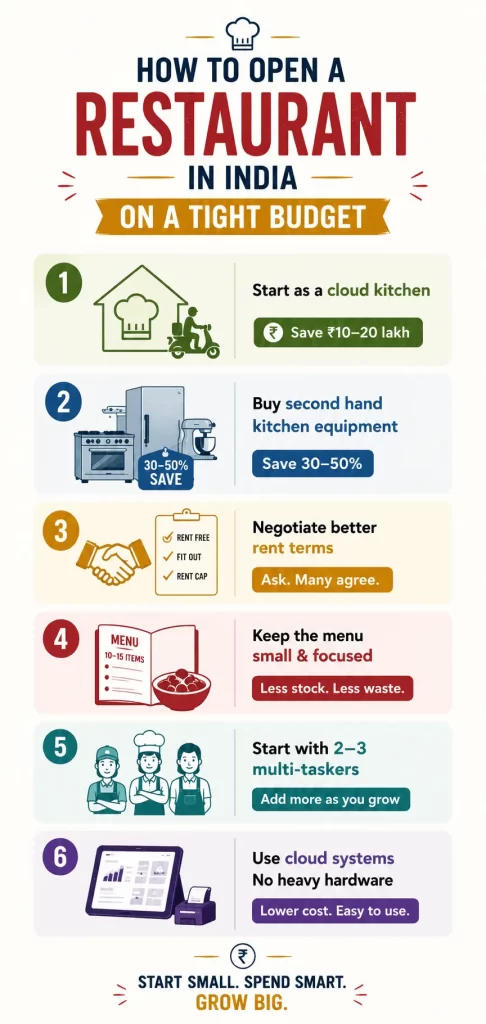
- Start as a cloud kitchen first then expand to a physical space once you have proven demand & built a loyal customer base. This saves Rs. 10 to 20 lakh in rent & interiors upfront.
- Buy second hand commercial kitchen equipment from trusted suppliers or online platforms. You can save 30 to 50 percent on your kitchen setup cost without compromising on food quality.
- Ask for a rent free period of 2 to 3 months, a fit out contribution from the landlord & a cap on annual rent increases. Many landlords in India will agree if you ask.
- A 10 to 15 item menu costs far less to stock & manage than a 50 item menu. It also means faster kitchen training & less wastage.
- Instead of hiring separate people for every role, start with 2 to 3 people who can handle multiple tasks. Add more staff as revenue grows.
- Modern cloud based systems cost less upfront than traditional software & require no expensive hardware beyond a tablet & a printer.
8. Frequently Asked Questions
Is a restaurant business profitable in India?
Yes, when managed well. Restaurant profit margins in India are typically 5 to 15 percent of revenue. Cloud kitchens can break even in 12 to 18 months. Casual dining usually takes 24 to 36 months. Location, food cost control & strong marketing are the biggest profit drivers.
What licenses are needed to open a restaurant in India?
You need an FSSAI license, GST registration, Trade license from your Municipal Corporation, Fire NOC & an Eating House License. If you serve alcohol you need a State Liquor License too. Total cost is usually Rs. 25,000 to Rs. 2 lakh depending on your state & restaurant size.
How much does it cost to open a fast food restaurant in India?
A fast food or QSR format in India typically costs Rs. 10 to 30 lakh depending on location & size. A delivery first fast food setup starts around Rs. 8 to 15 lakh. A counter service format with seating in a Metro area can reach Rs. 25 to 40 lakh.
9. Conclusion
Opening a restaurant in India is absolutely possible on a range of budgets. Whether you have Rs. 5 lakh or Rs. 5 crore, there is a format that fits your plan. The key is to be honest about your budget, plan for every cost category including working capital, & start with a format that matches your experience level.
Cloud kitchens & small QSRs are the smartest entry points for first timers. Casual dining & fine dining work well for experienced operators with strong backing. Wherever you start, focus on food quality, customer experience & smart financial management.
Your restaurant journey starts with knowing your numbers. Now you do. Go build something great.