


Quick Summary |
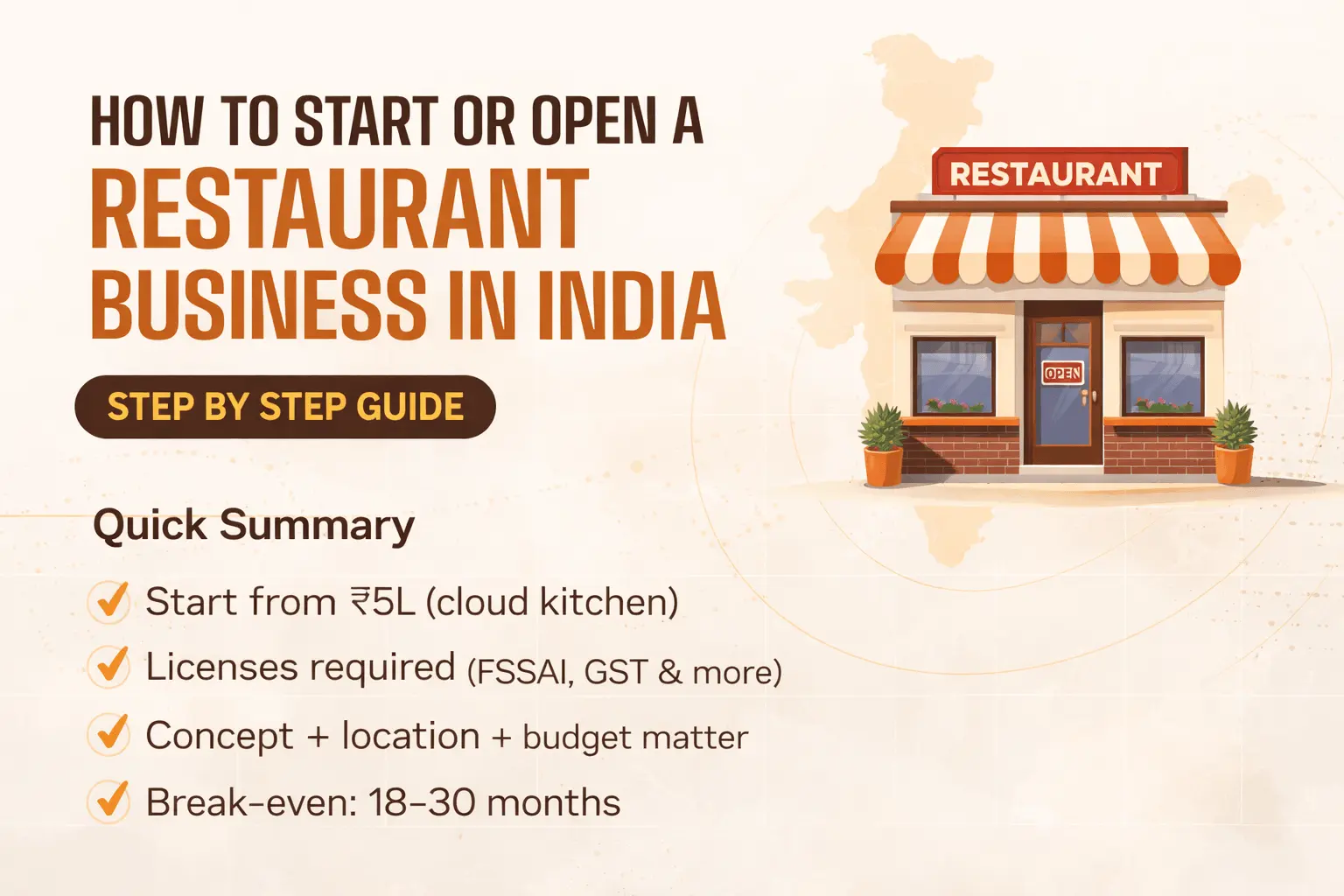
| ✓ India is one of the fastest growing food markets in the world, making it a great time to start. |
| ✓ You can open a restaurant with as little as Rs. 5 Lakh if you start with a cloud kitchen. |
| ✓ You need an FSSAI license, GST registration & at least 4 to 6 other licenses before opening. |
| ✓ A clear concept, good location & a tight budget plan are the three things that matter most. |
| ✓ Most restaurants in India break even between 18 to 30 months of opening. |
| ✓ Even with no experience or no money, there are smart formats like cloud kitchens to get started. |
Should You Open a Restaurant in India?
So you want to open a restaurant. Great idea. India is one of the biggest food markets in the world & it is still growing fast. The food service industry in India is expected to cross Rs. 7.76 lakh crore by 2028. That is a huge opportunity.
But here is the honest truth. Running a restaurant is tough. Around 60% of restaurants in India shut down within their first year. Not because the food was bad but because the owner did not plan well.
This guide is for anyone who wants to open a restaurant in India. Whether you are a first timer, a home cook, someone switching careers, or an investor, this step by step guide covers everything you need to know.
Things to Know Before You Open a Restaurant
Before you spend a single rupee, there are some things you must understand. These are the basics that most first timers skip & then regret later.
Do Your Market Research First
Look at the area where you want to open. Who are the people living there? What do they eat? What is already available? If there are 5 biryani shops in the same lane, maybe do not open a sixth one. Find a gap in the market.
Know the Real Costs
A lot of people underestimate what it costs to open a restaurant in India. The cost depends a lot on your city & your concept. A small cloud kitchen in a Tier 2 city will cost very differently compared to a full service restaurant in Mumbai or Bangalore.
Understand Why Restaurants Fail
The top reasons restaurants fail in India are overspending on setup, poor location choice, bad cash flow management & ignoring customer feedback. Knowing these upfront will help you avoid the same mistakes.
Plan for the Timeline
From the day you decide to open to the day you actually serve your first customer, plan for at least 6 to 12 months. This includes finding a location, getting licenses, doing the interiors & hiring staff.
Step 1: Choose Your Restaurant Concept & Format
This is the first real decision you need to make. What kind of restaurant do you want to open? In India, you have several formats to choose from.
- Quick Service Restaurant (QSR): Think fast food. Low ticket size, high volume. Good for street food, wraps, burgers & similar.
- Casual Dining Restaurant: A sit down place with a full menu. Mid range pricing.
- Cloud Kitchen: No dine in. Only delivery via Swiggy or Zomato. Very low setup cost. Best for beginners.
- Cafe: Coffee, snacks & light meals. Popular in metro cities with young crowds.
- Fine Dining: High end food & service. Very high investment but also high margins.
If you have no experience in running a restaurant, a cloud kitchen or a small QSR is the smartest way to start. You do not need a big space, fancy interiors or a large team. You just need good food & fast delivery.
Once you pick your format, define your USP. What makes your restaurant different? What cuisine? What price point? Who is your target customer? Answer these questions before you move to the next step.
Step 2: Write a Business Plan
A business plan sounds like a big corporate thing but it does not have to be. Even a simple one page plan is enough when you are starting out. The idea is to put your thoughts on paper so you can see if the numbers actually work.
What to Include in Your Restaurant Business Plan

In India, most mid size restaurants break even somewhere between 18 to 30 months. Your plan should show how you will manage cash flow until that point.
If you are planning to apply for a bank loan or get investors, a proper business plan is not optional. It is required.
Step 3: Fund Your Restaurant
Money is usually the first thing people worry about when they think of opening a restaurant. But the good news is that you do not always need a huge amount to get started.
| Restaurant Type | Estimated Investment | Best For |
| Cloud Kitchen | Rs. 5 to 10 Lakh | Beginners with low budget |
| Quick Service Restaurant (QSR) | Rs. 10 to 30 Lakh | Fast food concepts |
| Casual Dining Restaurant | Rs. 30 to 50 Lakh+ | Mid level dining experience |
| Fine Dining Restaurant | Rs. 60 Lakh+ | Premium high end market |
One area where new owners often overspend is the kitchen itself. Before you finalize your budget, read our detailed guide on restaurant kitchen equipment setup cost so you know exactly what to expect & where you can save money.
Where to Get the Money From
- Self funding: Using your own savings. Most common for small & cloud kitchen setups.
- Bank loans: You can apply for a business loan from any scheduled bank. The MUDRA loan scheme (under Pradhan Mantri Mudra Yojana) is specifically for small businesses & covers up to Rs. 10 lakh without collateral.
- Government schemes: PMEGP (Prime Minister Employment Generation Programme) gives subsidies for new food businesses. Many state governments also run food park schemes.
- Investors or partners: You can bring in a silent partner who funds the restaurant in exchange for a profit share.
How to Start a Restaurant With No Money
Yes, it is possible. Here is how people actually do it.
- Start with a cloud kitchen. You can rent a shared kitchen space for as low as Rs. 15,000 to Rs. 25,000 per month.
- Use the ghost kitchen model where you cook out of your home kitchen initially (only for delivery & only where legally permitted).
- Find a partner who can fund while you run the operations.
- Start very small, one or two dishes only, build a customer base & then reinvest.
“Cloud kitchens have completely changed the game for first time restaurant entrepreneurs in India. You can validate your food concept with a fraction of the investment that a traditional restaurant would need. Start lean, learn fast.” Ananya Bhat, Co-founder, DarkKitchen India & Startup Food Advisor |
Step 4: Find the Right Location & Set Up Your Space
If you are opening a dine in restaurant, location is everything. A bad location can kill even the best food.
What to Look for in a Location
- High footfall: Are there enough people walking past every day?
- Visibility: Can people see your restaurant from the road?
- Parking: Especially important in Tier 1 cities.
- Competition: How many similar restaurants are in the same area?
- Rent vs revenue potential: Do not pay Rs. 1.5 lakh rent for a location that can only generate Rs. 3 lakh revenue per month.
Lease Tips
Always negotiate your lease. Try to get a revenue sharing model instead of a fixed rent in the beginning. Get a lock in period of at least 3 years so you are not asked to leave just when your restaurant picks up. Make sure the fit out clause is clear so you know who pays for the interiors.
Setting Up the Space
The kitchen to dining ratio for a standard restaurant should be around 1:2. That means if your total area is 600 square feet, around 200 square feet goes to the kitchen & 400 square feet for seating. Always keep workflow, safety & ventilation in mind when designing the kitchen.
Step 5: Get Your Licenses & Legal Registrations Done
This is one of the most important steps & also the one most people delay. Do not make that mistake. In India, running a restaurant without proper licenses can get you fined or shut down.
| License | Issued By | Who Needs It |
| FSSAI License | Food Safety Dept | All food businesses |
| GST Registration | Income Tax Dept | Turnover above Rs. 20L |
| Shop & Establishment License | Local Municipality | All commercial setups |
| Fire NOC | Fire Department | All restaurants |
| Eating House License | Local Police / Municipality | Dine-in restaurants |
| Liquor License | State Excise Dept | If serving alcohol |
| Music License | IPRS / PPL | If playing recorded music |
FSSAI License: What You Need to Know
Every food business in India needs an FSSAI license. There are three types. Basic registration for businesses with turnover below Rs. 12 lakh per year. State license for turnover between Rs. 12 lakh to Rs. 20 crore. Central license for large chains & manufacturers.
You can apply for FSSAI online at foscos.fssai.gov.in. Documents needed include your ID proof, address proof, business registration & a site plan of your food premises.
GST Registration
If your annual turnover crosses Rs. 20 lakh, you must register for GST. Restaurants have two GST options. The composition scheme charges 5% GST with no input tax credit. The regular scheme charges 5% GST on non AC restaurants & 18% on AC restaurants but gives you input tax credit on purchases.
Business Registration
Sole proprietorship is the simplest & cheapest for a single owner restaurant. LLP or Private Limited is better if you have co-founders or want to raise investment. Talk to a CA to decide what is right for your setup.
“Getting your FSSAI license & GST registration done on Day 1 is not just about legal compliance. It builds trust with your customers, your vendors & your delivery partners. Platforms like Swiggy & Zomato will not list you without it.” CA Priya Mehta, Chartered Accountant specialising in F&B & Hospitality Businesses, Mumbai |
Step 6: Build Your Menu & Manage Sourcing
Your menu is the heart of your restaurant. But a great menu is not just about good dishes. It is about dishes that are profitable to make & easy to deliver consistently.
Menu Engineering Basics
Use the classic menu matrix to evaluate every dish.
- Stars: High popularity, high profit margin. Keep these & promote them.
- Plowhorses: High popularity, low profit margin. Find ways to reduce cost.
- Puzzles: Low popularity, high profit margin. These need better marketing.
- Dogs: Low popularity, low profit margin. Remove these from the menu.
In India, a healthy food cost percentage is between 28% to 35%. If you are spending more than that on ingredients for a dish, either reprice it or remove it.
Sourcing & Vendor Management
Build relationships with at least 2 to 3 vendors for each key ingredient so you are never stuck. Local market vendors are cheaper but less consistent. Centralised suppliers or food aggregators give better consistency but at a higher cost. For a new restaurant, start with local vendors & move to centralised supply as you scale.
Step 7: Hire & Train Your Team
Even if you are starting small, you need the right people. A one person restaurant is possible for a cloud kitchen but for any dine in setup, you will need a team.
Minimum Team for a Small Restaurant
- 1 head cook or chef
- 1 to 2 kitchen helpers
- 1 cashier or front desk person
- 1 to 2 servers for dine in
You can find staff on platforms like Apna, Indeed India & local WhatsApp groups in your city. Hotel management institutes are also a great source for trained front of house staff.
Training Is Not Optional
Train every team member on basic food hygiene as per FSSAI standards. Set clear SOPs (Standard Operating Procedures) for how to take orders, how to plate dishes & how to handle complaints. A trained team means consistent food & consistent service.
Step 8: Set Up Technology & Get Online
In 2024, a restaurant without an online presence is invisible. Here is what you need to set up before you open.
Point of Sale (POS) System
A restaurant POS system is the brain of your billing & order management. It tracks every order, generates GST compliant bills & gives you daily sales reports. Top options for Indian restaurants include Foodship, Petpooja, Posist & GoFrugal.
If you are wondering how much to budget for this, check our breakdown of restaurant POS cost in India. Most basic plans start at Rs. 1,000 to Rs. 3,000 per month.
Not sure which hardware to buy? Our guide on how to get a POS machine will walk you through the options. If you are still comparing different billing setups, this detailed comparison of Cash Register vs POS vs MPOS vs EPOS vs Swipe Machine vs EFTPOS will help you pick the right one for your restaurant.
Food Ordering & QR Code Setup
Once your POS is in place, the next step is connecting it to a food ordering system that handles both in-restaurant & online orders in one place. This saves your staff a lot of time & reduces order errors.
Many Indian restaurants are now using a QR code ordering system at tables so customers can scan, order & pay without waiting for a waiter. It cuts down on staff cost & speeds up table turnover. Worth setting up even for a small restaurant.
Get Listed on Food Delivery Apps
Register on Swiggy & Zomato as soon as you have your FSSAI license. Commission rates are typically 18% to 30% per order. Optimise your listing with good photos, clear descriptions & competitive pricing. Getting your first 50 reviews is the most important milestone. Focus on that.
ONDC (Open Network for Digital Commerce) is also growing fast & has lower commissions. Worth exploring as an additional channel.
Basic Digital Presence (Free)
- Google My Business: Set it up so people can find you on Google Maps.
- Instagram: Post food photos regularly. This is free & very effective for local discovery.
- WhatsApp Business: Great for repeat customer communication & offers.
Step 9: Plan Your Launch & Marketing
Most new restaurants rush to open & then wonder why no one is coming. Plan your launch like a campaign, not just a day.
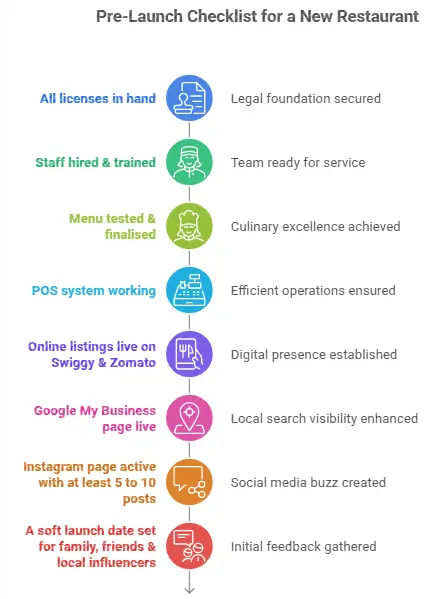
Pre Launch Checklist
Soft Launch First
Do a soft launch a week before your official opening. Invite friends, family & a few local food bloggers. Get feedback. Fix issues. Then do your grand opening when you are actually ready.
Local Marketing on a Budget
Marketing does not have to be expensive. We have a full list of proven marketing ideas for Indian restaurant businesses that work even on a tight budget. To get you started, here are the basics.
- Drop flyers in nearby residential societies & offices
- Post in local Facebook & WhatsApp groups
- Offer a launch discount for the first two weeks
- Ask early customers to leave a Google & Zomato review
“Your first 100 customers are everything. Treat them like VIPs. Get them to review you on Google & Zomato. Word of mouth still drives the majority of new restaurant customers in India, especially in Tier 2 & Tier 3 cities.” Vishal Sood, Restaurant Growth Strategist & Founder, RestroScale |
How to Run a Successful Restaurant After Opening
Opening is just the beginning. What you do in the first 6 months after opening will decide whether your restaurant survives or closes.
Track These Numbers Every Week
- Food cost percentage: Should stay between 28% to 35%.
- Labour cost percentage: Should stay below 30% of revenue.
- Average ticket size: The average amount each table or order spends.
- Table occupancy rate: For dine in restaurants.
- Online rating: Keep Zomato & Swiggy rating above 4.0.
Focus on Customer Retention
It is 5 times cheaper to retain an existing customer than to get a new one. Set up a simple loyalty program. Even something like a stamp card works. Reply to every review online, good or bad. Ask customers for feedback directly.
When to Think About Scaling
Do not think about opening a second location until your first restaurant is consistently profitable for at least 6 months. Signs you are ready to scale: your kitchen is running at full capacity, customers are waiting too long & you have stable revenue month on month.
Frequently Asked Questions
How long does it take to open a restaurant in India?
On average, plan for 6 to 12 months from decision to opening day. This includes finding a location, signing a lease, doing interiors, getting licenses & hiring staff. Cloud kitchens can be set up faster, sometimes in 8 to 12 weeks.
Can I start a restaurant from home or as a cloud kitchen?
Yes, a cloud kitchen is one of the best ways to start with low investment. You rent a commercial kitchen space & only do home delivery via Swiggy or Zomato. You do not need a dine in space. You still need an FSSAI license & GST registration.
What licenses are needed to open a restaurant in India?
At minimum you need an FSSAI license, GST registration, Shop & Establishment License & a fire NOC. If you are serving alcohol, you also need a liquor license from the state excise department. The exact list can vary a little based on your city & state.
Starting a restaurant in India is not easy. But it is very much doable if you plan well, start lean & stay focused on your customer. Follow these steps one at a time & you will have a strong foundation to build on.